
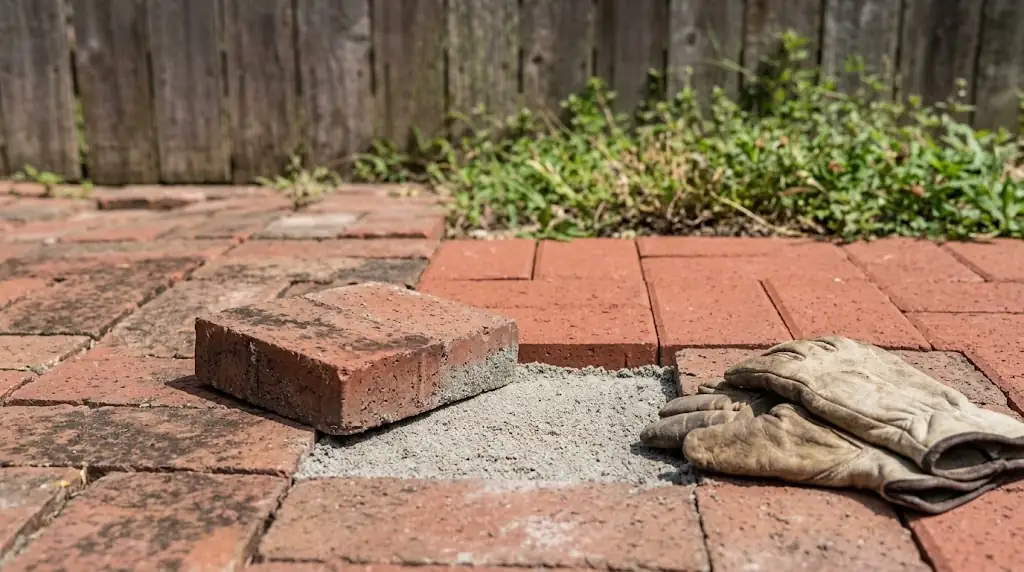
Even the best-laid patios and driveways eventually need a little help. The beauty of choosing interlocking pavers over a solid slab of poured concrete is that when something goes wrong, you don’t have to tear up the entire yard and start over. Pavers are individual units, which makes them inherently repairable. At McKinney Pavers, we specialize in diagnosing and fixing sinking, shifting, and damaged pavers across McKinney, TX, getting your outdoor space back to looking and functioning perfectly.
Why Pavers Fail in Our Area
If you have a section of pavers that is dipping, waving, or pulling apart, it is rarely the fault of the paver itself. The problem almost always lies underneath.
Here in McKinney, TX, we build on heavy, expansive clay soil. When it rains heavily during the spring, that clay swells up and holds a massive amount of water. When the blistering heat of August hits, the clay dries out, shrinks, and cracks. This constant expansion and contraction is brutal on hardscapes. If the original installer did not dig down deep enough or didn’t use the correct base materials, that movement in the clay will transfer right up through the sand and into your pavers, causing them to heave upward or sink down.
Another major culprit is poor water management. If a downspout is dumping hundreds of gallons of rainwater directly onto the edge of your patio, or if the patio wasn’t graded with enough of a slope to shed water away from the house, that pooling water will slowly wash away the bedding sand underneath the stones. Once the sand washes out, the pavers have nothing to sit on and they simply drop, creating low spots that hold even more water.
The Danger of Ignoring Sunken Pavers
A sunken section of your walkway or a raised edge on your pool deck might just seem like a minor cosmetic annoyance right now, but ignoring it usually leads to bigger, more expensive problems.
First and foremost, uneven pavers are a massive trip hazard. If an edge is raised by even half an inch, it is incredibly easy for someone to catch a toe and fall. Secondly, low spots hold standing water. In McKinney, TX, a puddle of standing water quickly becomes a breeding ground for mosquitoes.
Finally, a failing patio will eventually compromise the rest of the installation. Interlocking pavers rely on the tight friction of the sand between their joints to stay locked together. When one area sinks, the joints open up. This allows weeds to aggressively take root in the gaps and gives water a direct path down to the base material, accelerating the damage and causing the sunken area to grow larger over time.
How We Fix the Problem
We don’t just throw some extra sand on top of a sunken hole and call it fixed. That is a temporary band-aid that will wash away after the next big thunderstorm. We fix the root cause of the problem.
Our repair process starts with carefully extracting the affected pavers. We pull them up by hand, clean off the old sand, and set them aside. Then, we excavate the failing base underneath. If we find that the original base was built with the wrong material—like round pea gravel that refuses to compact, or plain dirt—we will dig it out.
We then rebuild the foundation correctly. We add dense-grade crushed stone and compact it aggressively with heavy machinery. We screed a fresh layer of coarse concrete sand to create a perfectly flat bed, and then we reinstall your original pavers, matching the existing pattern flawlessly. Once they are set, we sweep in high-quality polymeric joint sand and compact the surface to lock everything tightly back into place.
Edge Restraint Failures
If the pavers along the very outside edge of your driveway or patio are drifting outward and creating wide, ugly gaps, you are experiencing edge restraint failure.
Every paver installation needs a solid border to hold the field of stones tightly together. Many older installations used cheap plastic edging held in by thin metal spikes. Over time, the expanding soil and the constant pressure of the pavers push those spikes right out of the ground, and the plastic border bows outward.
To fix this, we pull back the drifting edge pavers and completely remove the failing plastic edging. We then reinstall the pavers tightly and lock them in place using a poured concrete edge restraint, often called a concrete toe. This creates a heavy, invisible concrete wedge around the entire perimeter of your patio that is buried underground and will never rust, rot, or pop out.
Replacing Stained or Damaged Blocks
While concrete pavers are incredibly tough, they aren’t invincible. An old oil leak from a car in the driveway, a dropped hammer, or a severe rust stain from cheap patio furniture can ruin the look of a stone.
Because pavers are modular, replacing a stained or chipped block is a straightforward job. We use specialized extraction tools to carefully pry the damaged block out without disturbing the surrounding stones. We then drop a fresh, matching paver into the gap. Keep in mind that a brand new paver might look slightly brighter than the ones that have been baking in the McKinney, TX sun for five years, but it will eventually weather and blend in naturally.
Don’t let a failing patio become an eyesore or a safety hazard. We can stabilize the foundation and level your hardscape properly. Head to our contact page to get a quote on your paver repairs.