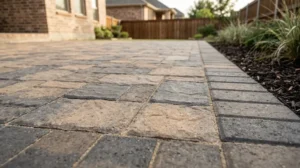
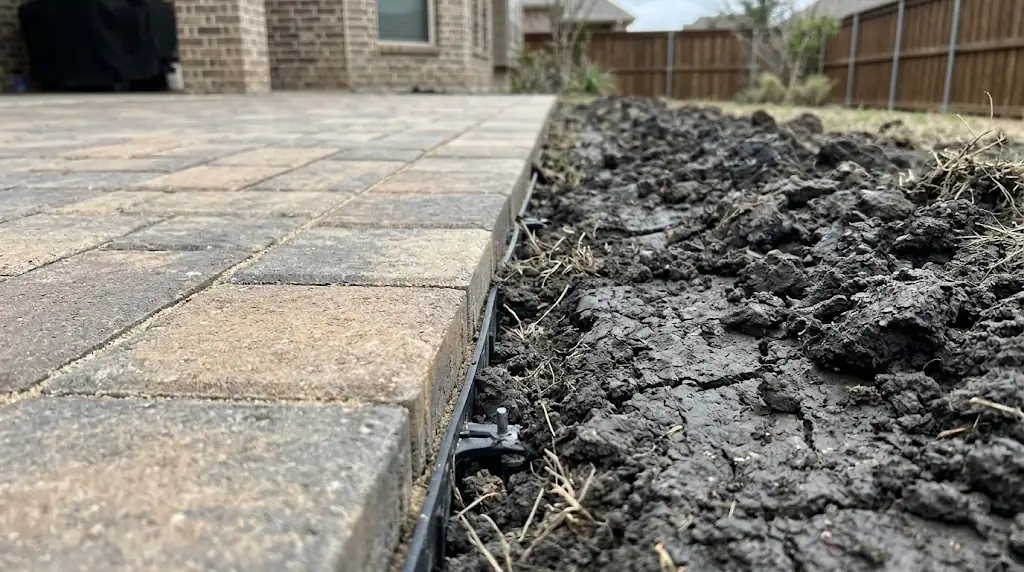
North Texas black clay soil causes unreinforced hardscapes to heave, crack, and sink because its high montmorillonite mineral content expands by up to 40% when wet and shrinks dramatically during dry summer droughts. Unlike rigid poured concrete slabs that fracture under this constant ground movement, interlocking paver systems flex across sand-filled joints without structural cracking when installed over a deeply excavated aggregate base lined with geotextile separation fabric.
The Mechanics of Houston Black Clay in Collin County
Collin County sits directly on the Texas Blackland Prairie belt. The predominant native soil series—Houston Black clay—is classified as a vertisol, a dense soil profile known for extreme shrink-swell cycles.
The Seasonal Movement Cycle
- Wet Season (Spring and Fall): Heavy rain saturates the dense clay particles. The soil expands up to 40% in total volume, creating upward vertical swell pressures exceeding 5,000 pounds per square foot against hardscape foundations.
- Dry Season (Summer Heat Waves): Triple-digit temperatures evaporate subterranean moisture. The clay shrinks rapidly, causing the ground to pull away, drop in elevation, and open surface fissures 2 to 4 inches wide and several feet deep.
- The Impact on Pavements: When a continuous, rigid surface like a poured concrete slab sits atop this shifting ground, the loss of uniform support snaps the concrete across stress points. Segmental pavers eliminate this issue by distributing kinetic load across individual units and flexible joints.
Soil Engineering Metrics in North Texas
- High Plasticity Index (PI): Collin County clay frequently measures a Plasticity Index between 35 and 50+, ranking it in the highest category of soil expansiveness.
- Low Permeability: Native clay absorbs standing water at exceptionally slow rates (often less than 0.05 inches per hour), causing severe surface pooling and saturated subgrades after typical Texas storms.
Why Pavers Outperform Poured Concrete in Expansive Clay
Rigid materials resist ground movement until the structural tension exceeds tensile strength, resulting in permanent cracking. Interlocking pavers work in harmony with soil movement.
| Performance Attribute | Interlocking Paver Systems | Standard Poured Concrete | Stamped Concrete |
| Structural Flexibility | High; joints absorb subterranean shifts | Zero; rigid monolithic slab | Zero; rigid monolithic slab |
| Shrink-Swell Resilience | Zero surface fractures; joints micro-adjust | Severe jagged cracking over time | Fractures compromise decorative patterns |
| Weight Distribution | Interlock distributes loads across adjacent units | Concentrates point loads directly over voids | Concentrates point loads directly over voids |
| Repair Process | Lift stones, re-level base, reset seamlessly | Cosmetic patching leaves visible scars | Matching original color and stamp is nearly impossible |
| Lifespan in Texas Clay | 30 to 50+ Years | 10 to 15 Years (before cracking) | 8 to 12 Years (before surface spalling) |
The 4 Engineering Standards Required for Collin County Paver Installations
Standard builder-grade paver installations designed for sandy or rocky soils will fail quickly in North Texas. Constructing long-lasting hardscapes over black clay requires an engineered cross-section.
Engineered Paver Cross-Section for Expansive Soil
| Layer Order | Component | Depth / Thickness | Specification & Purpose |
| Top Layer | Surface Pavers | 2-3/8″ (Patios) to 3-1/8″ (Driveways) | High-density concrete pavers (8,000+ PSI compressive strength) |
| Bedding Layer | Concrete Bedding Sand | Exactly 1″ | Coarse, washed ASTM C33 sand; creates uniform interlock |
| Base Layer | Compacted Crushed Stone | 6″ (Patios) to 10″–12″ (Driveways) | TxDOT Type A Grade 1 crushed limestone, compacted in 2″ lifts |
| Barrier Layer | Geotextile Separation Fabric | Single continuous layer | 6 to 8 oz. non-woven polypropylene; prevents base stone sinking |
| Subgrade | Native Houston Black Clay | Excavated 8″ to 14″ total depth | Mechanically compacted to 95% Standard Proctor Density |
1. Deep Excavation Below Organic Topsoil
Shallow 4-inch digs settle within 12 months. Excavation depth must reach stable subsoil:
- Patios and Walkways: Require an excavation depth of 8 to 10 inches to house the full aggregate profile.
- Driveways: Require an excavation depth of 12 to 16 inches to counteract vehicle wheel loads against shifting subgrades.
2. Heavy-Duty Geotextile Separation Fabric
Geotextile fabric is the single most critical structural element when building on Texas clay.
- The Aggregate Sinking Trap: Without a separation barrier, crushed stone base gravel sinks directly into softened clay during wet months. Within two seasons, half the base stone disappears into the mud below, creating uneven depressions on the surface.
- The Solution: A heavy-duty, non-woven geotextile fabric installed directly over the native clay subgrade keeps the stone base separate from the mud while allowing water to filter through. Seams must overlap by at least 12 to 18 inches and run up the excavation walls.
3. Layered Mechanical Compaction
Dumping 6 inches of base gravel into a trench and running a compactor over the top leaves the bottom loose. Base aggregate must be installed and compacted mechanically in 2-inch lifts. Each layer requires a commercial vibratory plate compactor running at 98% Standard Proctor Density to create an immovable foundation.
4. Positive Drainage Slope and Heavy-Duty Edge Restraints
- Grading Slope: Hardscape installations must slope away from building foundations at a minimum rate of 1/4 inch per linear foot (a 2% drop) to shed surface water before it saturates the clay underneath.
- Anchored Edge Restraints: Clay movement pushes unrestrained pavers outward. Heavy-duty commercial edge restraints secured with 10-inch steel spikes driven every 12 inches lock the perimeter stones in place.
Local Municipal Soil and Drainage Considerations
Hardscape planning must account for local municipal codes across Collin County:
- McKinney: The City of McKinney enforces strict drainage regulations that prevent homeowners from diverting surface water across neighboring lot lines or obstructing established drainage swales between residential properties.
- Frisco: Frisco properties face tight impervious surface coverage caps (often capped at 45% to 50% of the total lot area depending on zoning). Adding non-permeable patio space that exceeds these limits may require the use of permeable interlocking concrete pavers (PICP).
- Plano and Allen: Older neighborhoods in Plano and Allen feature established root systems. Digging near mature trees requires careful root zone management to avoid destabilizing both the hardscape base and the tree canopy.
- Prosper, Lucas, and Fairview: Larger residential lots often feature septic tanks and aerobic spray fields, requiring hardscape installations to maintain designated setbacks from utility lines and distribution boxes.
How to Protect Your Pavers From Soil Movement Over Time
Homeowners can take three proactive steps to preserve their paver investments:
- Maintain Consistent Perimeter Moisture: Extreme drought shrinks soil away from the edges of patios and driveways. Running a drip irrigation line or soaker hose through perimeter garden beds during July and August prevents severe soil shrinkage around hardscape edges.
- Keep Polymeric Sand Joints Full: High-performance polymeric sand locks pavers together, stops weed growth, and prevents heavy rainwater from penetrating straight down into the subgrade.
- Extend Roof Downspouts: Never allow gutter downspouts to empty directly onto or alongside a paver border. Route downspout extensions at least 5 to 10 feet away from hardscape surfaces into lawn areas or dedicated catch basins.
Build Long-Lasting Hardscapes in Collin County
A paver patio or driveway installed over North Texas black clay will perform reliably for decades if the ground preparation accounts for regional soil science. Skipping deep excavation, skimping on base aggregate, or leaving out geotextile fabric leads to premature hardscape failure. McKinney Pavers builds engineered outdoor spaces tailored specifically to the challenging soils of McKinney, Frisco, Allen, Plano, Prosper, Lucas, and Fairview. To plan your next outdoor hardscape project with an engineered foundation, contact our team today.